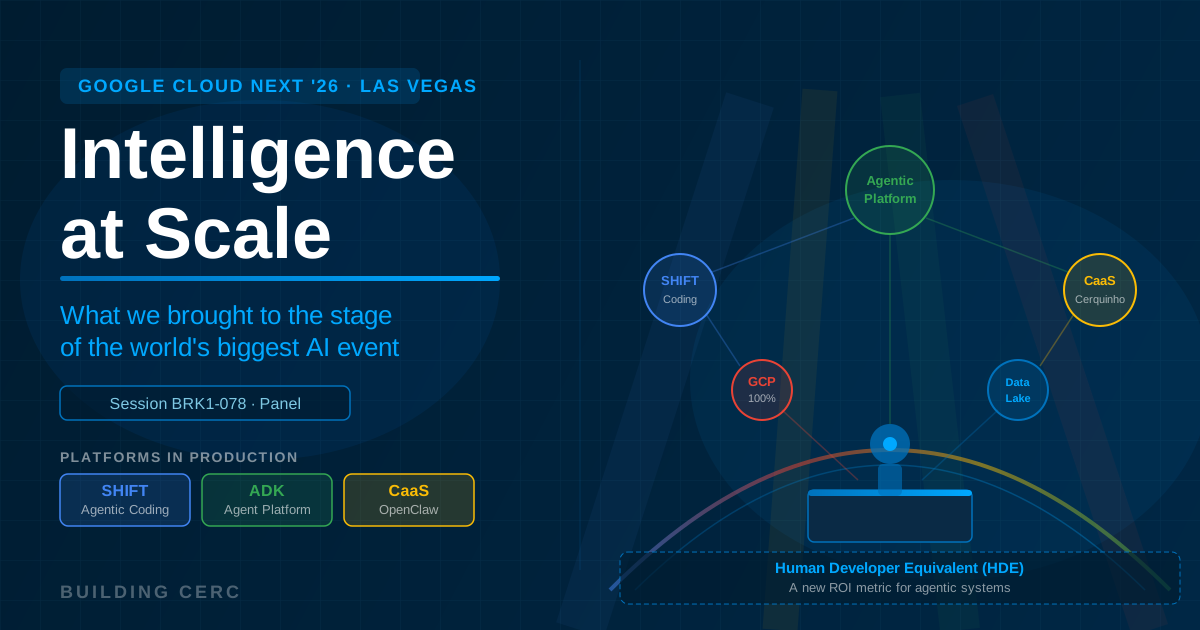
Intelligence at Scale: What We Brought to the Google Cloud Next '26 Stage
In April 2026, Las Vegas hosted one of the year’s largest technology events: Google Cloud Next ‘26. More than 32,000 leaders, engineers, and partners gathered to discuss the definitive shift from generative AI to what Google calls the Agentic Era — the moment when language models stop answering questions and start executing work autonomously.
I had the privilege of participating as a panelist in session BRK1-078: “Intelligence at Scale: The AI-driven Financial Enterprise”, alongside executives from other global financial sector organizations. It was a rare opportunity to discuss, on an international stage, what it truly means to build a financial enterprise genuinely driven by artificial intelligence — not as an aspiration, but as an operational reality.
This post summarizes the key points I brought to the discussion and the reflections that stayed with me.
CERC as Financial Market Infrastructure
For those unfamiliar with us: CERC is a financial market infrastructure regulated by the Brazilian Central Bank. We operate as a central receivables registry — card receivables, trade receivables, CCBs, credit rights — connecting originators, assignors, financiers, registrars, and custodians within an ecosystem that moves trillions of reais annually.
Beyond the regulatory role, we build data products that enable market participants to enter new markets, identify risks, structure operations, and make decisions based on information that, until CERC’s creation, simply did not exist in consolidated form. This dual nature — critical infrastructure + data company — was the thread running through my entire panel participation.
Overcoming the Scale Bottleneck: Data, Governance, and GCP
The first question the panel explored was: how are financial companies overcoming scale limitations to put AI into production?
CERC’s answer begins with our technical foundation. We are 100% cloud-native on GCP — no proprietary data centers, no relevant on-premise legacy. Our entire data platform and Data Lake run on Databricks on GCP, giving us real elasticity and the ability to process volumes that grow at the same pace as the Brazilian credit market.
But data scale alone doesn’t solve the AI challenge in finance. The real bottleneck is governance of sensitive data. Since part of our core business is precisely creating products from third-party financial data, we already had reasonable maturity in this area — however, the growth of AI initiatives made it necessary to formalize and automate this process.
Last year, in partnership with Google, we ran a Data Governance project in which we used Gemini to systematically classify and catalog our datasets. The model evaluates the semantics, context, and sensitivity of each dataset, generating classifications that, after validation by responsible owners, directly feed our access control and compliance policies. All of CERC’s internal models operate on this metadata, ensuring that data protection rules aren’t just documents — they are executed at the infrastructure layer.
The Agentic Leap: Three Platforms in Production
The second dimension of the panel was about autonomous action — how to go beyond chatbots and build systems that actually do things.
At CERC, we developed three distinct platforms to enable productive AI at scale:
SHIFT — Autonomous Agentic Coding Platform
SHIFT is our autonomous coding agent platform. Built on Vertex AI and Cloud Run, it instantiates short-lived agents that receive an engineering task such as: implement a feature, fix a bug, write tests, or review a pull request. The agent executes the task autonomously and terminates. The ephemeral nature is intentional: each agent starts from zero with no accumulated state, making control and auditing straightforward.
SHIFT is not a coding assistant. It is an autonomous developer operating within guardrails defined by the platform team. All CERC teams have already integrated SHIFT into their workflows, and several are already customizing automated integrations for autonomous executions.
Agentic Platform — ADK + Agent Engine
For our other business agents, we built a unified platform based on Google’s ADK (Agent Development Kit) and Agent Engine. The goal was to ensure that all agents in the company — regardless of who built them — operate with the same controls, traceability, and security standards. Standardization not as bureaucracy, but as the condition for scaling without losing governance.
OpenClaw as a Service
The third platform is perhaps the most strategically significant from a cultural perspective. After a rigorous security testing process, we created CaaS — Cerquinho as a Service — an environment where any CERC employee can instantiate their own OpenClaw agents securely and integrate them into their daily work. All guardrails are embedded in the platform. Everything is audited. Access is controlled by policy, not bureaucracy.
The logic is simple: if people are going to use AI anyway, it’s better that they do so within an environment the company controls and can observe.
The ROI of Intelligence: A New Metric
One of the most lively discussions in the panel was about ROI. How do you justify AI investments to a board that wants to see numbers?
At CERC, we use all the traditional metrics commonly applied to measure AI impact, but traditional productivity metrics alone — lines of code per hour, tickets closed per sprint — don’t adequately capture what happens when agents enter the equation. For SHIFT, we created a proprietary metric: the Human Developer Equivalent (HDE).
The logic is as follows: given the cost of a task executed by an agent (in tokens and compute), how many hours would a human developer need to complete the same task manually to arrive at the same cost?
The result is revealing: there is an entire class of engineering tasks that would be economically unviable to delegate to humans at the volume and speed at which agents operate. It’s not that agents replace developers — it’s that they execute work that simply would not get done otherwise.
Empowering People: The Cultural Challenge
The part of the discussion that generated the most interest after the panel — in conversations with the audience — was about people and culture. Rightfully so — it’s where the real work lives.
At CERC, we are still in transformation. What helps us enormously is that leadership and founders are genuinely engaged — not merely authorizing AI initiatives, but using the tools themselves, talking about them publicly, and signaling that this matters. When the behavior comes from the top, culture changes faster.
We are revisiting processes and policies to be AI-first: how we hire, how we train, how we evaluate performance. Not as cosmetics, but as structural change.
And here is the dilemma that occupied me most during the panel: how do you empower people without amplifying risks?
A concrete example: many people from business and back-office areas began asking us how they could put into production applications they built through vibe coding. It’s a legitimate question — the tools are accessible, the creativity is there. But deploying unreviewed code to production, in a regulated financial infrastructure company, creates real risks.
We are developing policies and practices to make this possible safely. We don’t have all the answers yet. But the question itself is a healthy signal — it indicates that people want to participate in the transformation, not merely watch it, and that they are concerned about doing so safely.
What Other Leaders Can Take Away
If I could summarize my panel participation in one sentence, it would be this:
AI is a matter of culture and people, not just technology.
The technology is available, accessible, and mature enough for production. What differentiates companies that are advancing from those that are stuck is not the technical stack — it’s the experimentation mindset, the tolerance for mistakes as part of the learning process, and leadership’s ability to create safe space for that to happen.
Google Cloud Next ‘26 was a reminder that the Agentic Era is not science fiction. For many organizations — including CERC — it is already the present. The question now is how much of the future each of us can bring into today.
André Racz is CERC’s CIO, responsible for Infrastructure, Cloud, SRE, Artificial Intelligence, Architecture, and Information Security.